Better Feedback - Better Decisions

"Better decisions are always dependent on feedback of current state of affairs. Better decisions executed well will return high proportion of positive feedback.Strong feedback gathering mechanism is the key to better decision making and execution on an ongoing basis"
Showing posts with label Employee Engagement. Show all posts

Tuesday, September 17, 2013

Oh No , Not again !!

I just read this article that was featured in DNA a few weeks back. Titled “To deal with attrition, companies extending notice period” it spoke about how Organisations IT-ITeS firms are increasingly extending notice periods from one to three months to dissuade poaching of staff. In order to safeguard their business interests, companies in the IT-ITeS sector are increasingly introducing longer notice periods for employees leaving their fold.

My first reaction was Oh No! I mean how short sighted can Organisations get .While yes ,it probably dissuades employees from leaving and Competitor organisation from poaching it hardly helps the cause.

Disengaged employees are surely a bigger threat than having employees leave. Instead shouldn't Organisation focus on keeping their employees engaged and improve retention.

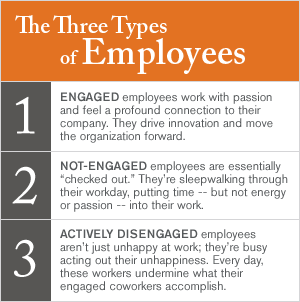
Gallup talks about 3 kinds of employees:

KEY: The Three Types of Employees


It’s very evident that by not letting employees who want to leave, Organisations are only creating more Disengaged employees who have a direct negative impact on Morale of other team members, performance & productivity

HR teams today need to get creative with their solutions and look at identifying root causes of dissatisfaction. Instead of planning on increasing hiring numbers they need to figure out why employees are leaving in the first place.

What can Organisations do to improve employee engagement?

1.      Create a 2 way mechanism to capture employee feedback on a continuous basis
2.      Work on the feedback and monitor actions being implemented
3.      Communicate with the employees

As always I will be happy to hear from you on what you think Organisations can do to keep their employees engaged.

Friday, April 5, 2013

FIRST MINUTES ARE CRITICAL IN NEW-EMPLOYEE ORIENTATION


A brilliant article published in the Harvard Business Review 

The first few minutes of new employee orientation, if done right, can lead to happier and more productive workers and, ultimately, increased customer satisfaction. Unfortunately, a lot of companies do it wrong.

In many firms, employee orientation focuses solely on corporate culture and identity of the new workplace. There's a lecture about the firm's history and another about standard operating procedures. There's a packet of information from human resources, emblazoned with the firm's logo, and maybe a coffee mug to match.

The underlying message: Welcome. You should be proud to work here. Please fit in accordingly.

But research suggests that employee orientation ought to be less about the company and more about the employee. A research team finds that shifting the focus to an employee's personal identity leads to an increase in both employee retention and customer satisfaction.

"The researchers hypothesized that companies would see positive performance results by emphasizing employee individuality from day one, testing their hypothesis through a series of field and lab experiments.

For starters, they conducted a field study at Wipro, a major business process outsourcing company based in Bangalore, India, that provides telephone and chat support for its global customers. Traditionally, Wipro's orientation for call center employees consisted of an informational session about the company, followed by several weeks of training in which new call agents) must demonstrate proficiency in English, as well as an aptitude for following standard procedures during customer calls.

Individuality was not just discounted; in some ways it was expressly discouraged. "As a service role, the job can be stressful, not only because employees must help frustrated customers with their problems, but because Indian call center employees are often expected to 'de-Indianize' many elements of their behaviour—for example, by adopting a Western accent and attitude," the paper explains.

Wipro was dealing with a big dropout dilemma; more than half of its call center employees quit only a few months after training. "Wipro presented us with the problem of figuring out whether there was anything we could do to reduce turnover," Gino says. "We thought it was the perfect environment to test whether we could make a difference just by changing something minor in the onboarding process."

IDENTITY EXPERIMENTS

In the field experiment, the researchers divided batches of new call agents into a control group , individual identity group, and an organizational identity group, individual identity group

The control group went through the traditional process, focused on firm awareness and skills training. The two identity groups received the same training as the control group, but also an additional hour-long presentation, which varied according to the group.

For the individual identity condition, a senior leader at Wipro spent 15 minutes discussing ways in which working at the company would enable the newcomers to express their individuality. Next, the new call agents completed an exercise ranking the individual strengths they would exhibit if stranded on a life raft at sea; they also spent time considering how their responses might differ from their colleagues'. Then, the agents answered a series of questions about their individual strengths such as, "What is unique about you that leads to your happiest times and best performance at work?" Finally, the agents shared their strengths with their future office mates.

At the end of the session, employees in the individual identity group received fleece sweatshirts embroidered with their individual names, along with a name badge. They were asked to wear them for the duration of employee training.

For the organizational condition, new employees spent 15 minutes listening to a senior Wipro leader and a "star performer" at the company talk about why Wipro was a singular place to work. Next, the newcomers spent 15 minutes writing answers to questions such as, "What did you hear about Wipro today that you would be proud to tell your family about?" Finally, the group members discussed their answers with each other.

At the end of the session, employees in the organizational identity group received fleece sweatshirts embroidered with the company name, along with a badge. They were asked to wear them for the duration of employee training.
Seven months later, the researchers looked into whether the orientation changes affected how long the newcomers/agents chose to stay with the company. "Considering we just changed one hour on the first day of orientation, the results were amazing," Gino says.

The turnover rate in the control group was 47.2 percent higher than that of the individual identity group, and 16.2 percent higher than that of the organizational identity group. And turnover was 26.7 percent higher in the organizational identity condition than in the individual identity condition. Additionally, employees in the individual identity group had garnered higher customer satisfaction scores during the seven months than those in the control group.

LESSONS FOR BUSINESSES

For employers, the implications of the findings are pretty clear: "Given that the standard, organization-focused approach of employee socialization is so common, it would benefit managers to think about an alternative approach where there's more room for newcomers' self-expression, Gino says. "This is a pivotal stage of the employee/employer relationship, and there are ways to emphasize people's individuality so they can bring it out into their jobs. To Wipro's credit, after seeing the results of the study, the company redesigned its employee orientation process such that personal identity socialization is a part of it."
Read the entire article here: http://hbswk.hbs.edu/item/7193.html

Tuesday, November 30, 2010

Oh the challenges of recruitment

My friends in BPO Recruitment teams across several companies are in a terrible mood. Everyone seems to be pissed off with their jobs, hate their peers and are upset with their colleagues .

The problem seems to be common. They run a stiff number target ( gosh when will employees be referred to as people and not numbers), somehow manage to meet the target, only to be told that the quality of hires were poor and hence they failed assessments and now the next weeks target has gone up by 20%.
The recruitment heads argument was that I get the people in , you should be able to keep them . I can’t be held responsible if you can’t get them to stay back . Interesting but that’s definitely not the solution, as I can imagine the Ops head saying get me good people and I will definitely get them to stay and the story goes on …

While a lot of debates take place in board rooms I think there could be a solution . By studying data of employees who have left over a year and mapping it with their profile could give an indication of which profiles tend to stay longer than the others. Now that does not mean that Companies shouldn’t hire the ‘not ideal’ profiles. It at least gives a starting point . Feedback could go to the Ops team that these employees need to watched a little more closely, Managers should engage with them more and perhaps the current situation will improve..

Any thoughts , please share them.

Wednesday, March 24, 2010

Appraisal Satisfaction Survey - The Need of the Hour

It is appraisal time and everyone is running behind deadlines and trying to complete the process within the stipulated time. Something I have never understood considering that appraisals & feedback should be a continuous process.

One thing that you hear the most during this season is the dreaded word ' Bell Curve'. No one knows what it means and the ones who do , cant seem to care to explain.

One of the best practices given my experience of working with several companies is to conduct an Appraisal Satisfaction Survey, to understand the effectiveness of the entire process.

Its is important to understand an employees expectations and experience based on which the Organisation can ensure that the overall experience improves and thereby enhance employee engagement.

The question is how many companies want to ?

Sunday, February 28, 2010

What do we want from our jobs ?

A couple of weekends back I was having drinks with a few of my friends from the HR world at TGIF ( I passed by it this evening and it was closed , due to the tragic incident that took place at Carlton Towers earlier this week) and the conversation led to a discussion around what do employees expect from their jobs ?

We debated a bit and Money was the most popular answer (not unanimously though). I urged the group to think beyond money and they came up with several responses. Let me try and list the most accepted ones out (not in any particular order) :
Career aspirations
Most employees take up a job in hope that they can build a career in the company, perform well and grow within the company.
A Good Manager
Employees like to have a manager whom they can look up to, someone they can learn from, someone who is fair, who recognises them and someone who will stand by them.
Work life Balance
Employees like to be able to have a “Personal” life too
A “Positive” Company
A company that is progressive in the way it thinks. A company that believes that its employees are among the most valuable resources. A company that focuses on developing its employees and a company that invests in Employee Engagement. Overall a company who does everything that it can to ensure that the employees are Happy and look forward to coming to work the next morning

By now I had them scribbled out on a napkin, and when we looked back at the list it seemed so simple.
I asked my dear friends if they did everything they could, to make sure that employees at their respective workplaces met these objectives. Since we were at a restaurant and not in a Board room, they were honest to admit that they didn’t.

One of them was bold enough to ask what she should do to fix it. This time however the answer was unanimous. “Ask the employees”

Tuesday, January 26, 2010

Bye Bye 2009

I wonder what 2009 will be remembered for, or will people even want to ever remember it .We at AceNgage too, had our ups and downs, more downs that ups, predictably.


Through the year I met a lot more HR heads than in the previous year. I would joke with them, that earlier they had the money to spend, but not the time, now they have the time to spend and not the money.


On a positive note, it helped us to sit back and strategise and look at what our Customers want. We then went back to the drawing board and tweaked our services and in 2009 launched our "Coaching For Manager program" & "Counselling services to Employees". Both of which have been received by our Customers well.


We are also launching our new website and I can’t tell you how excited we are about it. Hang in there and very soon you should be able to view it .

Wednesday, December 2, 2009

Low Attrition yet high Disengagement

A couple of years back when attrition was at its peak most organisations were struggling to find out why people were leaving and till date have not been able to figure it out...With the economic downturn Companies breathed a sigh of relief as attrition was not a cause for a concern anymore. Little did they realise that the problem is far greater now than before.


In the past disgruntled employees would leave and find jobs at other companies. However based on several surveys that we have done recently, it is evident that there is a bigger problem on hand. The problem being disgruntled employees not quitting. So now companies have an added problem of poor performance and morale.High performers continue to get jobs thereby the percentage of disgruntled Cat B performers is on the rise.


Companies ought to realise this and ensure that they pay attention to Employee Engagement at this crucial time inspite of the fact that Attrition may be low. In the past Attrition was a reflection of the general satisfaction level of the employees, not anymore.